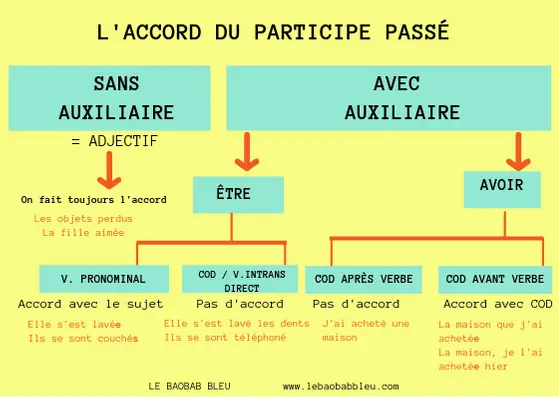
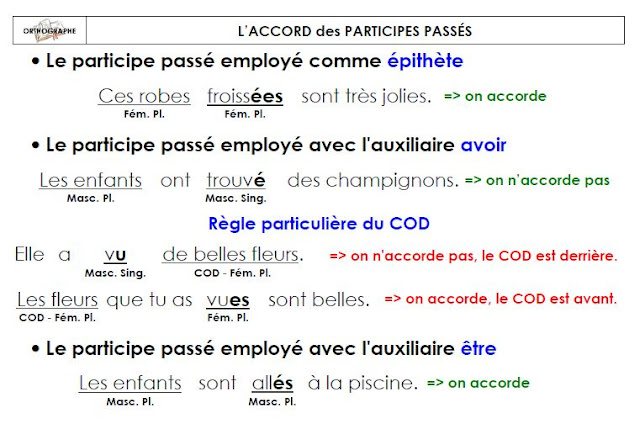
Alright, allons-y! Let’s talk about something that might sound a little scary at first: the agreement of the past participle with the auxiliary verb avoir in French. Sounds like a mouthful, right? But trust me, it's not as daunting as it seems. In fact, it's kind of like a hidden puzzle, and once you figure it out, you'll feel like a French grammar ninja!
What’s the Deal with Avoir?
So, first things first. Remember how we use “to have” (avoir) as a helping verb in the past tense (passé composé)? Think of it like this: "I have eaten", "She has seen," "We have danced." In French, it's "J'ai mangé," "Elle a vu," "Nous avons dansé." Simple enough, right?
But here's where things get a little interesting… sometimes, the past participle (that "eaten," "seen," "danced" part) agrees in gender and number with something lurking in the sentence.
The Agreement: When and Why?
Okay, so when does this agreement happen? This is key: The past participle agrees with the direct object of the verb if that direct object comes before the verb in the sentence.
Confused? Let's break it down:

- Direct Object: The thing (or person) that directly receives the action of the verb. Think of it as answering the question "Who?" or "What?" after the verb. For example, in "I ate the apple," the apple is the direct object.
- Before the Verb: This is the tricky part. It means the direct object has to be positioned before the verb and the auxiliary avoir.
Think of it like this: the direct object is showing off, saying "Hey, look at me! I'm so important, the past participle has to match me!"
Examples to Make it Crystal Clear
Let’s look at a couple of examples:
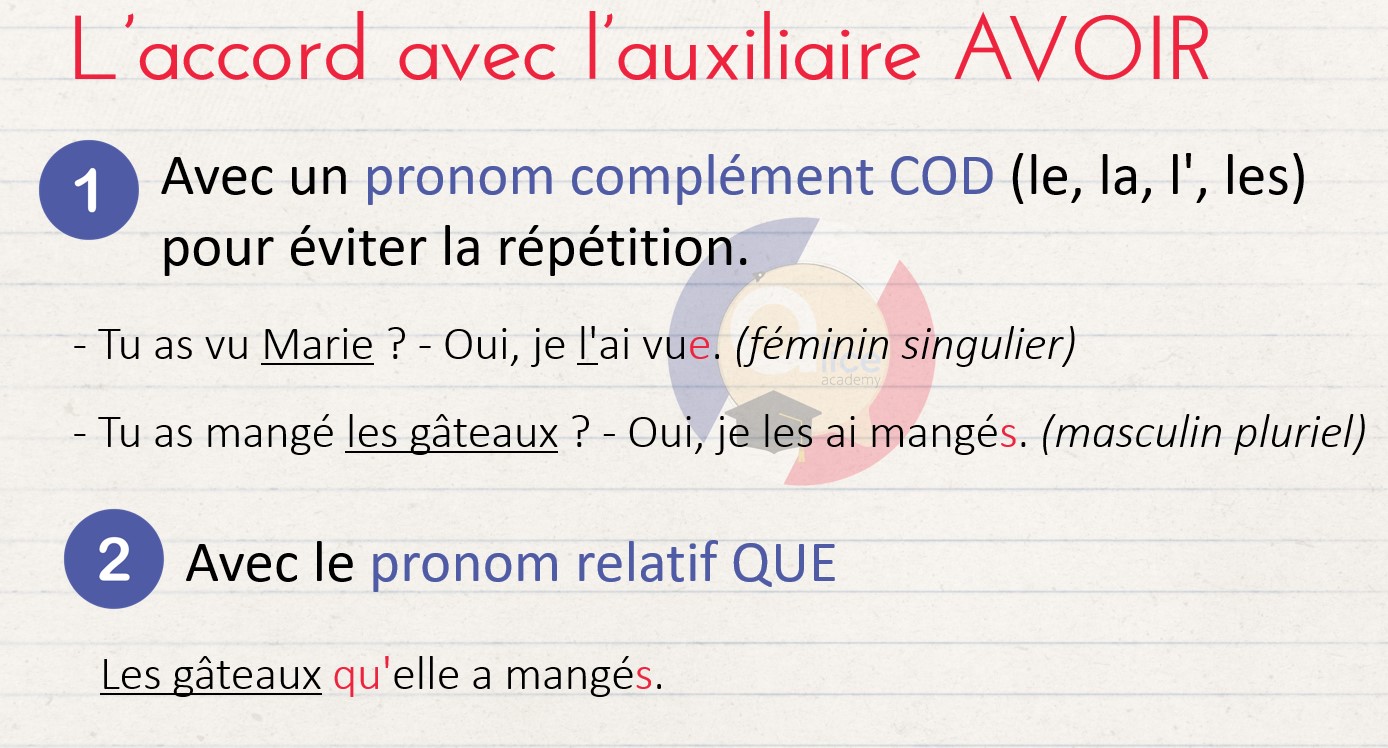
- "J'ai mangé des pommes." – "I ate some apples." Here, "des pommes" (some apples) is the direct object, but it comes after the verb. No agreement! The past participle "mangé" stays the same.
- "Les pommes que j'ai mangées étaient délicieuses." – "The apples that I ate were delicious." Aha! Now "les pommes" (the apples) comes before the verb because of the relative pronoun "que". Now we need agreement! Since "pommes" is feminine plural, we add an "-es" to "mangé," making it "mangées." See the difference?
It’s all about that placement!
Why is this Cool?
You might be thinking, "Why do I even need to know this?" Well, it's about taking your French to the next level! It shows a deeper understanding of the language and makes your sentences sound more polished and sophisticated. It's like adding a secret ingredient to your French "recipe."
![[Carte mentale] L'accord du participe passé | Participe passé, Carte](https://i.pinimg.com/originals/68/e8/af/68e8af8dfa76286874ef220d0cbe2912.png)
Think of it like this: if speaking basic French is like riding a bike, mastering the agreement with avoir is like adding a super cool sound system to your bike and cruising down the street with style!
So, don't be intimidated! Practice makes perfect. The more you read and listen to French, the more you'll start to intuitively understand this rule. And who knows? Maybe you'll even start spotting these agreements in everyday conversations. Bonne chance!




.jpg)