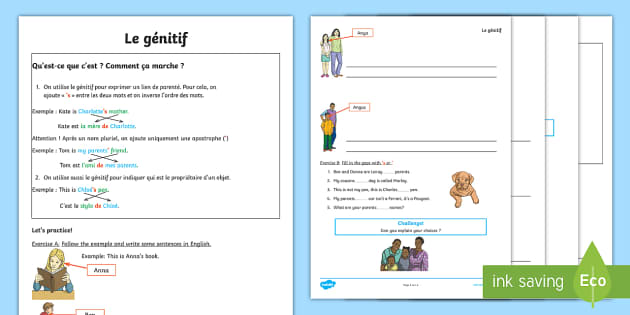
Alors, C'est quoi le génitif en anglais? That sounds terribly academic, doesn't it? Like something you'd only encounter in dusty grammar books or when prepping for a super-serious English exam. Mais, détends-toi! It's actually something you use every single day, probablement sans même t'en rendre compte.
Imagine this: you're at a picnic. There's a blanket, sunshine, and… ants! You exclaim, “Oh no! These are Sarah’s cookies!”
Boom! There it is. The "’s" tacked onto Sarah's name? That's the genitive (or the possessive adjective, for a fancier term) in action. It's all about showing ownership or a close relationship. Sarah owns those cookies (or at least, she brought them!).
Why Should You Care About This ‘s Thing?
Okay, okay, so you're using it already. Why bother understanding the rules? Well, misusing the genitive can lead to some seriously awkward (and sometimes hilarious) situations. Think of it like this: it's the difference between accidentally wearing your socks with sandals (a minor faux pas) and showing up to a black-tie event in your pajamas (a major fashion disaster). Clarity, my friend, clarity is key!
Besides, mastering the genitive opens doors. You'll express yourself more precisely and confidently. You'll avoid those little grammatical stumbles that can make you sound less articulate. And, qui sait? Maybe you'll even impress a native English speaker or two with your surprisingly polished grammar!
The Basic Rule: ‘s for Singular Nouns
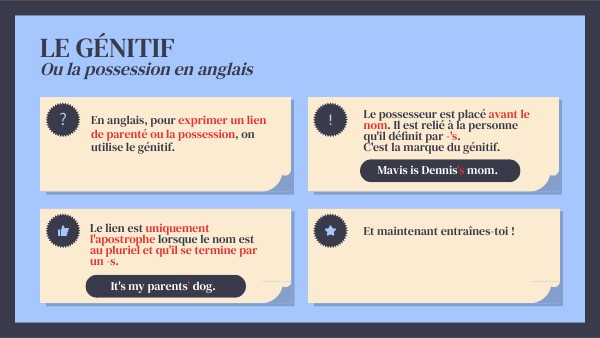
We touched upon this already with Sarah's cookies. The most common way to form the genitive is by adding 's to a singular noun. So, let's break it down with a few more everyday examples:
- The dog’s bone: The bone belongs to the dog. Simple, right?
- My brother’s car: My brother owns (or drives) the car.
- The teacher’s desk: The desk that the teacher uses.
Think of it like a little sign saying, "Hey! This belongs to this person or thing!"

What About Plural Nouns?
Here’s where it gets slightly more interesting. For plural nouns that already end in 's', you simply add an apostrophe (') after the 's'.
- The students’ books: The books belong to the students.
- My parents’ house: The house where my parents live.
- The Smiths’ car: The car that belongs to the Smith family.
Notice the difference? It's subtle, but important. The apostrophe after the "s" indicates that it's already plural.
Irregular Plural Nouns: A Small Twist
English loves to throw curveballs, doesn't it? Some plural nouns don't end in "s" (think children, men, women, people). For these, you add 's, just like with singular nouns.
- The children’s toys: The toys that belong to the children.
- The men’s locker room: The locker room used by the men.
- The women’s restroom: The restroom for women.
- The people's choice: The choice that the people made.
Easy peasy, right?

Beyond Ownership: Showing Relationships
The genitive isn't just about owning things. It can also show a broader relationship or connection. Consider these:
- Yesterday’s news: News from yesterday. It shows a temporal relationship.
- The city’s best restaurant: The best restaurant in the city. It shows a locational relationship.
- A moment’s notice: A very short notice. It shows a unit of time.
It's like saying, "This thing is related to this other thing in some important way."
The "Of" Construction: An Alternative
Sometimes, instead of using the 's, you can use the "of" construction. For instance, instead of "The dog's bone", you could say "The bone of the dog". While both are grammatically correct, they often have slightly different nuances.
Generally, use 's for people, animals, and organizations. Use "of" for inanimate objects and abstract concepts.

For example:
- The leg of the table (more natural than "The table's leg")
- The importance of education (better than "Education's importance")
- The cover of the book (better than "The book's cover")
But remember, these are guidelines, not hard-and-fast rules. Sometimes, both options work just fine, and it comes down to personal preference and style. "The government's policy" and "The policy of the government" are both perfectly acceptable.
Avoiding Confusion: Double Genitives
This is where things get a little more nuanced, and honestly, you can probably get away with not worrying too much about this in everyday conversation. But for the sake of completeness… let's talk about "double genitives."
A double genitive is when you use both the 's and "of" together. For example: "a friend of my brother's".

This construction is used to indicate that you are talking about one among many things/people. So, "a friend of my brother's" means "one of my brother's friends." It doesn't mean you're talking about the one and only friend he has.
It's perfectly acceptable, but can sound a bit formal or even stuffy. In most cases, you can rephrase the sentence to avoid it altogether. However, there are situations when the double genitive is the best option.
Practice Makes Perfect!
Like any grammar point, mastering the genitive takes practice. Don't be afraid to experiment and make mistakes. The more you use it, the more natural it will become.
So, next time you're describing something that belongs to someone, remember Sarah's cookies. And remember that understanding the genitive is more than just grammar; it's about clear communication, confident expression, and avoiding those awkward grammatical mishaps that can turn a simple conversation into a source of amusement (for others!). Bonne chance!