
Salut tout le monde ! Ever looked at a graph, saw two lines crossing each other, and wondered, "Hey, what's that spot?" That spot, my friends, is the point of intersection! And figuring out its coordinates? That's what we're diving into today. Think of it like finding the treasure on a map – X marks the spot, and we're the intrepid explorers!
Pourquoi s'en soucier ? (Why even bother?)
Okay, I get it. Math can sometimes feel a bit…abstract. But trust me, finding those intersection points isn't just some random brain exercise. It pops up everywhere in the real world. Seriously!
- Economics: Remember supply and demand curves? Where they meet is the equilibrium point. That's the price where everyone's happy (or, at least, not too unhappy).
- Physics: Imagine tracking two objects moving on different paths. Where their paths intersect could tell you if they're going to collide... or, you know, just pass each other safely. Maybe they're two spaceships! Who knows?
- Computer Graphics: When designing games or even just making cool visuals, determining intersections is crucial for things like collision detection (so your character doesn't walk through walls!) and ray tracing (making those realistic reflections!).
- Navigation: Think about GPS. It uses satellites to determine your location. The intersection of signals from multiple satellites gives you your precise coordinates!
See? It's not just dusty old equations. It's about understanding how things connect and interact. Pretty cool, right? Think of it as detective work – you're uncovering hidden relationships between different pieces of information. Ready to become a mathematical Sherlock Holmes?
Comment on s'y prend ? (How do we actually do it?)
Alright, enough with the hype. Let's get down to the nitty-gritty. There are a few different ways to find those intersection coordinates. We'll focus on the main ones:
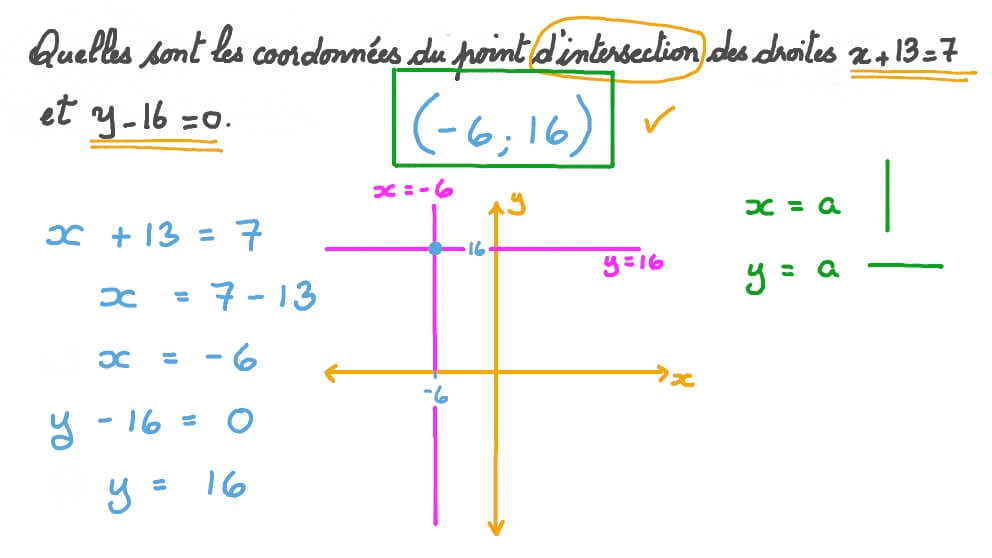
1. Graphiquement (Graphically)
This is the simplest, most visual approach. It's like looking at a map and literally seeing where the treasure is buried. All you need is a good, accurate graph!
Steps:
- Draw the graphs of both equations. Make sure your lines are straight and your curves are smooth!
- Look for where the graphs cross. Boom! That's your intersection point.
- Read the coordinates (x, y) of that point from the graph. Easy peasy!
Pros: Super intuitive and visual. Great for understanding what's actually going on. Cons: Not always accurate. Depends on how precise your graph is. Also, if the intersection point is way off the graph, you're out of luck!
Think of this as using a paper map – you can see the terrain, but the accuracy depends on the map's scale and how well it's drawn.

2. Algébriquement (Algebraically) – Substitution
This method is a bit more "hands-on" with the equations. It's like solving a puzzle where you have to rearrange the pieces to reveal the answer. The substitution method involves solving one equation for one variable and then substituting that expression into the other equation.
Steps:
- Solve one of the equations for one variable (either x or y). For example, if you have y = 2x + 3, you've already solved for y.
- Substitute that expression into the other equation. So, if your other equation is x + y = 5, you'd replace 'y' with '2x + 3' to get x + (2x + 3) = 5.
- Solve the resulting equation for the remaining variable. In our example, you'd solve x + 2x + 3 = 5 to find x.
- Substitute the value you just found back into either of the original equations to solve for the other variable. So, if you found x = 2, you could plug that into y = 2x + 3 to find y = 7.
Pros: More accurate than the graphical method. Works even if the intersection point is off the graph. Cons: Can be a bit more complicated, especially if the equations are messy.
This is like using a compass and protractor – more precise than just eyeballing it, but requires a little more skill.
3. Algébriquement (Algebraically) – Elimination
This is another algebraic method, but it uses a slightly different approach. It's like strategically canceling out parts of the equations to isolate the variable you want. The elimination method involves manipulating the equations so that when you add or subtract them, one of the variables cancels out.

Steps:
- Multiply one or both equations by a constant so that the coefficients of either x or y are opposites. For example, if you have x + y = 5 and 2x - y = 1, the 'y' coefficients are already opposites. But if you had x + 2y = 5 and 3x + y = 2, you could multiply the second equation by -2 to get -6x - 2y = -4.
- Add the two equations together. This should eliminate one of the variables. In our example (using the equations from step 1 as-is: x + y = 5 and 2x - y = 1), adding them gives 3x = 6.
- Solve the resulting equation for the remaining variable. In our example, 3x = 6 gives x = 2.
- Substitute the value you just found back into either of the original equations to solve for the other variable. So, if you found x = 2, you could plug that into x + y = 5 to find y = 3.
Pros: Can be very efficient, especially when the coefficients are easy to manipulate. Cons: Requires a bit of foresight to choose the right multipliers.
This is like using a GPS with advanced features – it automatically calculates the best route, but you need to understand how to set it up correctly.
Un exemple concret (A Real Example)
Let's say we have these two equations:
Equation 1: y = x + 1
Equation 2: y = -x + 3

We'll use the substitution method.
Since both equations are already solved for 'y', we can substitute the first equation into the second:
x + 1 = -x + 3
Now, solve for 'x':
2x = 2
x = 1

Now, substitute x = 1 back into either equation. Let's use the first one:
y = 1 + 1
y = 2
So, the point of intersection is (1, 2)! We found the treasure! Félicitations!
En Résumé (To Sum Up)
Finding the coordinates of intersection points is a fundamental skill with applications in tons of different fields. Whether you prefer the visual simplicity of graphing or the precision of algebraic methods, mastering this concept will definitely level up your math game. And who knows, maybe you'll even use it to find real-world treasure someday! Think about it – maybe hidden geological formations are best described by a system of equations… you could be onto something!
So, go forth and conquer those intersections! Don't be afraid to experiment with different methods and find what works best for you. And remember, math isn't about memorizing formulas – it's about understanding the relationships between things and using that understanding to solve problems. Bonne chance! (Good luck!) And happy intersecting!





..jpg)


