Ok, imagine this: you’re at a family dinner. Things are going smoothly, then BAM! Uncle Gérard launches into a passionate defense of… pineapple on pizza. The collective groan is almost audible. Aunt Monique rolls her eyes. Your little cousin starts crying because "pizza is sacred!" It's chaos. You just sit there thinking, "Why? Why does he do this every single time?" Well, Émile Durkheim, bless his sociological heart, would probably tell you it's not just about Uncle Gérard being a contrarian. It's about social facts. Yep, we're diving deep!
And by deep, I mean into Durkheim's Les Règles de la Méthode Sociologique (The Rules of Sociological Method). Don't worry, I won't make you read the whole thing in one sitting. Unless… that's your thing? No judgment here! 😉
What's the Big Deal with Durkheim?
So, Durkheim was kind of a big deal in the world of sociology. He basically wanted to make sociology a real science. Like, laboratory coats and rigorous testing and everything. Okay, maybe not the lab coats, but you get the idea. He wanted to move away from just making armchair observations and start actually proving things about society. Sound ambitious? Absolutely!
His main idea? Society isn't just a bunch of individuals running around doing their own thing. It's a force in itself. Think of it like this: a cake isn't just a pile of flour, eggs, and sugar. It's something more than the sum of its ingredients. Society, according to Durkheim, is the same way. It has its own rules, its own logic, and its own ways of influencing us.
Social Facts: The Heart of the Matter
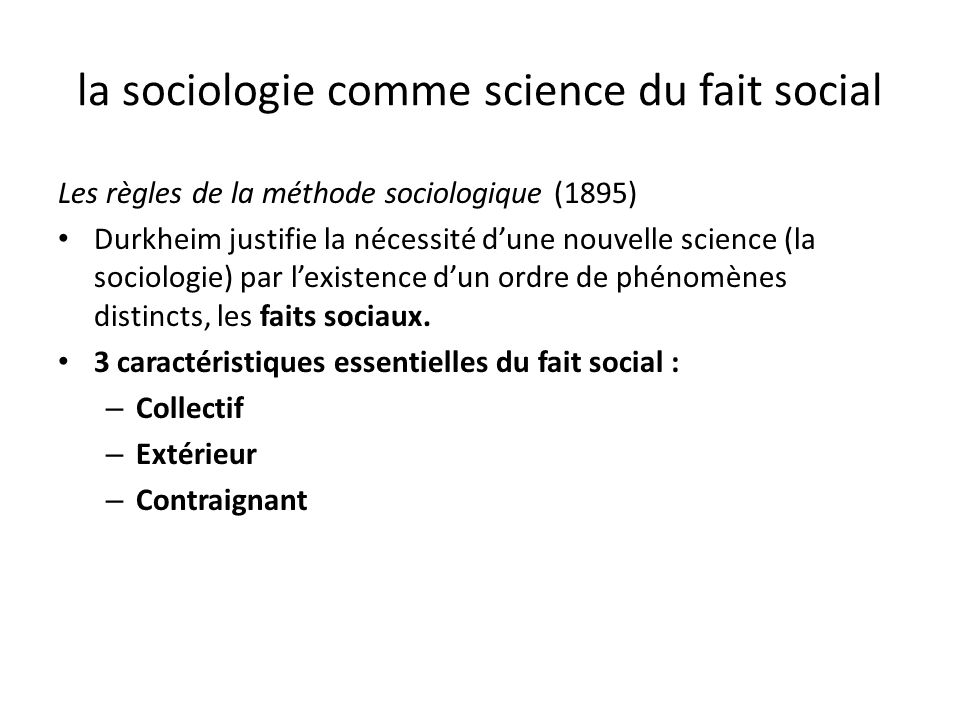
And here's where we get to the core of Durkheim's argument: social facts. These are the things that shape our behavior, our beliefs, and our attitudes. They are external to us as individuals, and they exert a coercive power over us. Coercive? Yeah, I know, sounds a bit intense, right? But think about it…

Social facts are basically the rules of the game. They're the norms, values, and institutions that we're all born into. They're the reason why you probably don't walk around naked in public (unless you're really trying to make a statement!). They're the reason why you (probably) don't steal from your neighbor (again, probably!).
Durkheim argues that these social facts are the proper subject matter of sociology. Sociologists shouldn't be focusing on individuals' motivations or psychological states. They should be focusing on these external forces that shape our lives. He wanted sociologists to treat social facts as "things." What a thing is, according to him, is anything that has some kind of permanence. Anything you can observe, compare and study. That also excludes studying it through introspection.
Think back to Uncle Gérard and his pineapple pizza obsession. Durkheim might argue that there are social facts at play here. Maybe there's a subculture that celebrates culinary rebellion. Maybe he's rebelling against traditional Italian norms. Maybe it is just something else... You see, it's not just about Uncle Gérard's personal taste. It's about the social context in which that taste exists.

Durkheim's Rules: A Sociological How-To Guide
So, how do we actually study these social facts? That's where Durkheim's "rules" come in. He lays out a set of principles for how to conduct sociological research. Here are a few key ones:
- Reject preconceptions: This one's huge. Durkheim argues that we need to shed our biases and assumptions when we study society. Don't just assume you know why people do things. Actually investigate. Easier said than done, right?
- Define your terms clearly: What exactly are you studying? Be precise. Don't just say "crime." What kind of crime? How are you measuring it? This is essential for making sure everyone is on the same page.
- Consider social facts as things: Remember, Durkheim wants us to treat social facts as objective realities. Observe them, measure them, compare them. Don't just rely on your gut feeling.
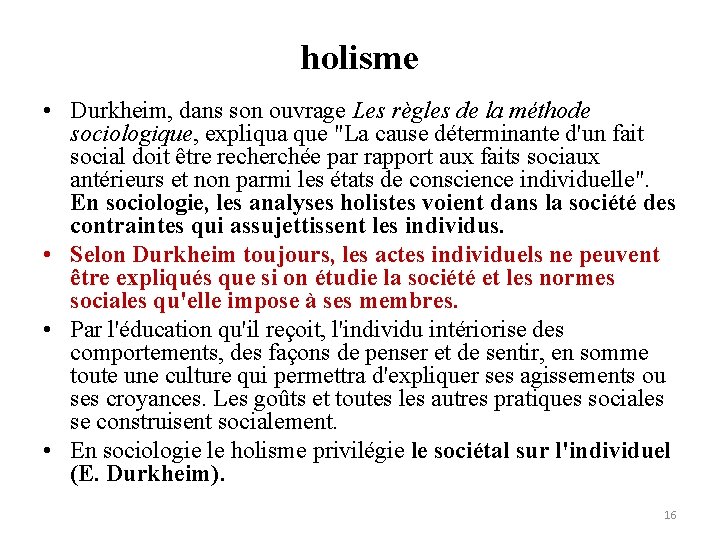
- Explain a social fact by another social fact: This is probably the most important rule. Durkheim argues that the cause of a social fact can only be another social fact. You can't explain a social phenomenon by appealing to individual psychology or biology. You need to look at the social forces at play.
For example, let's say you're interested in studying suicide. (Durkheim actually did study suicide, and it's kind of a classic sociological text). Durkheim would argue that you can't just explain suicide by saying that people are depressed or mentally ill. While those things might play a role, you need to look at the social factors that contribute to suicide rates. Are there high levels of social isolation? Are there economic pressures? Are there cultural norms that normalize suicide? These are the kinds of questions Durkheim would encourage you to ask.
Why Does This Still Matter Today?
Okay, so Durkheim wrote this stuff like, a century ago. Why should we still care? Well, his ideas are still incredibly influential in sociology. He helped to establish sociology as a legitimate academic discipline. And his focus on social facts is still relevant today. Seriously! Think about it…

We live in a world that is increasingly shaped by social forces. Social media, globalization, political polarization… these are all massive social phenomena that exert a powerful influence on our lives. Durkheim's work gives us a framework for understanding these forces and how they shape our behavior.
Plus, understanding social facts can help us to be more empathetic and understanding of others. When we realize that people's behavior is often shaped by social forces beyond their control, we might be less quick to judge them. Maybe Uncle Gérard isn't just trying to annoy everyone with his pineapple pizza. Maybe he's responding to some deeper social pressure that we don't even understand. (Okay, maybe he is just trying to annoy everyone. But still, food for thought! 😂)
Criticisms (Because Nothing's Perfect)
Of course, Durkheim's work isn't without its critics. Some argue that he overemphasizes the power of society and underestimates the role of individual agency. Are we really just puppets of social forces? Others argue that his focus on social facts is too deterministic. Does this mean we have no free will? And some find his writing a bit...dry. 🙈

These are all valid criticisms, and it's important to consider them when reading Durkheim. But even with its flaws, Les Règles de la Méthode Sociologique remains a foundational text in sociology. It's a book that challenges us to think critically about the world around us and to recognize the powerful forces that shape our lives.
So, next time you're at a family gathering and someone does something that makes you scratch your head, remember Durkheim. Remember social facts. And remember that there's probably more going on than meets the eye.
Now, if you'll excuse me, I'm going to go ponder the social implications of pineapple on pizza. 😉