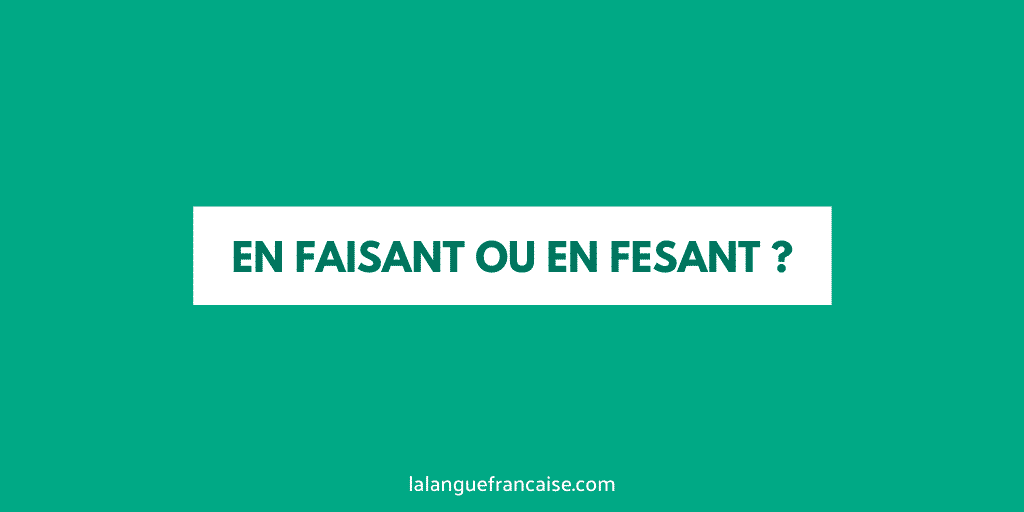
Hey toi ! Ever heard someone say something that just... sounds off? Like fingernails on a chalkboard, but for your ears? Well, let’s talk about a little French grammar gremlin called "En Faisant Ou En Fesant." (Spoiler alert: one is right, one is so wrong it's practically a crime against the French language. Just kidding… mostly.)
The Case of the Missing "ai"
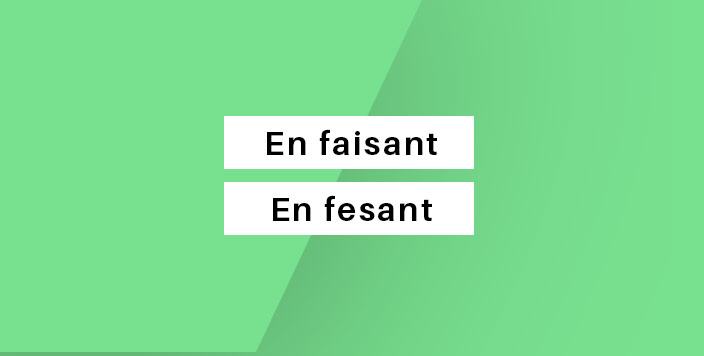
Okay, so here's the deal. You've got two contenders: En Faisant and En Fesant. Now, both look like they could be legit, right? Both seem to be related to the verb "faire" (to do, to make). But only one is the real McCoy. Can you guess which? (Dramatic pause for effect…)
It's En Faisant! Ta-da! Confetti explodes! Fireworks light up the sky! (Okay, maybe not. But you deserve a little celebration for sticking with me so far.)
But wait, why En Faisant and not En Fesant? Good question! Glad you asked! It all comes down to something called the present participle, or "participe présent" in French-speak. This is the form of the verb we use to describe an action that's happening at the same time as another action. Think of it like multitasking, but for verbs!
"Faire" and Its Participle Pal
The present participle of "faire" is formed from the verb's "nous" form (we do/make), which is "nous faisons." You chop off the "-ons" and slap on a "-ant" instead. Voila! Faisant is born! Pretty cool, huh?
So, En Faisant literally translates to "while doing" or "by doing." It's used to show how something is accomplished or to describe a simultaneous action.
Let's look at some examples to make it super clear. Imagine you're learning to play the guitar. You could say:
"J'apprends à jouer de la guitare en faisant des exercices tous les jours." (I'm learning to play guitar by doing exercises every day.)
See? The "doing exercises" (en faisant des exercices) is how you're achieving the "learning to play guitar" goal (j'apprends à jouer de la guitare). En Faisant provides the method or the means. It’s the secret sauce!
Or, picture this: you're walking and talking on the phone. You could say:
"Je parle au téléphone en faisant les courses." (I'm talking on the phone while doing the grocery shopping.)

Here, talking on the phone (je parle au téléphone) and doing the grocery shopping (en faisant les courses) are happening at the same time. Talk about being efficient!
En Faisant is your linguistic Swiss Army knife! It adds detail, context, and a touch of elegance to your sentences. It makes you sound like you know what you're talking about (even if you're just faking it till you make it – we've all been there!).
Why "En Fesant" is a No-Go
Okay, let's address the elephant in the room: En Fesant. Why is it wrong? Well, simply put, the verb "faire" doesn't conjugate that way. There's no "fesant" in any legitimate French conjugation table. It's a grammatical faux pas, a linguistic lemon, a total non. Think of it like trying to wear socks with sandals – it's just… wrong (unless you're really rocking the look, in which case, you do you!).
Using En Fesant will instantly mark you as a beginner (or someone who needs a serious French grammar refresher). Trust me, you don't want that. You want to impress people with your smooth French skills, not make them cringe inwardly (or outwardly, if they're particularly blunt!).
So, from now on, banish En Fesant from your vocabulary! Erase it from your memory! Pretend it never existed! Embrace the beauty and correctness of En Faisant. Your French will thank you for it.
Tips and Tricks for Mastering "En Faisant"
Alright, you're convinced. You're ready to unleash the power of En Faisant upon the world. But how do you make sure you're using it correctly? Here are a few tips:
- Practice, practice, practice! The more you use En Faisant, the more natural it will become. Write sentences, create dialogues, and try to incorporate it into your everyday conversations (even if you're just talking to yourself – hey, no judgment here!).
- Listen to native speakers. Pay attention to how they use En Faisant in real-life situations. Watch French movies, listen to French music, and eavesdrop on French conversations (discreetly, of course!). The more exposure you have, the better you'll understand the nuances of its usage.
- Don't be afraid to make mistakes! Everyone makes mistakes when they're learning a new language. The important thing is to learn from them and keep going. Think of each mistake as a stepping stone on the path to fluency.
- Have fun! Learning a language should be an enjoyable experience. If you're not having fun, you're doing it wrong. Find ways to make the process more engaging, whether it's through games, songs, or silly role-playing scenarios.
Remember, mastering En Faisant (and French grammar in general) isn't about perfection; it's about progress. Celebrate your small victories, don't get discouraged by your setbacks, and keep striving to improve. The journey is just as important as the destination.
Beyond "En Faisant": A World of French Awaits
So, we've conquered the mighty En Faisant! You now know the difference between the good, the bad, and the grammatically ugly. Give yourself a pat on the back! (Seriously, you deserve it.)
But this is just the beginning! The world of French grammar is vast and fascinating, filled with all sorts of linguistic treasures waiting to be discovered. There are subjunctives to master, conditional tenses to conquer, and a whole host of other grammatical goodies to explore.

Don't be intimidated! Learning French can be challenging, but it's also incredibly rewarding. It opens up a whole new world of culture, literature, and human connection. It allows you to communicate with millions of people around the globe and to experience the world in a richer, more meaningful way.
Think about all the amazing things you could do with your newfound French skills! You could travel to France and order croissants like a pro. You could impress your friends with your witty French banter. You could even read Proust in the original! (Okay, maybe that's a bit ambitious, but hey, dream big!)
So, what are you waiting for? Dive in! Embrace the challenge! Discover the joy of learning French! En Faisant des efforts, vous réussirez! (By making efforts, you will succeed!)
Start with a simple phrase a day. Watch a French movie with subtitles. Listen to a French podcast while you commute. Little by little, you’ll be amazed at how quickly you progress.
The possibilities are endless, and the rewards are immeasurable. Go forth and conquer the French language! Bonne chance, et amusez-vous bien! (Good luck, and have fun!)