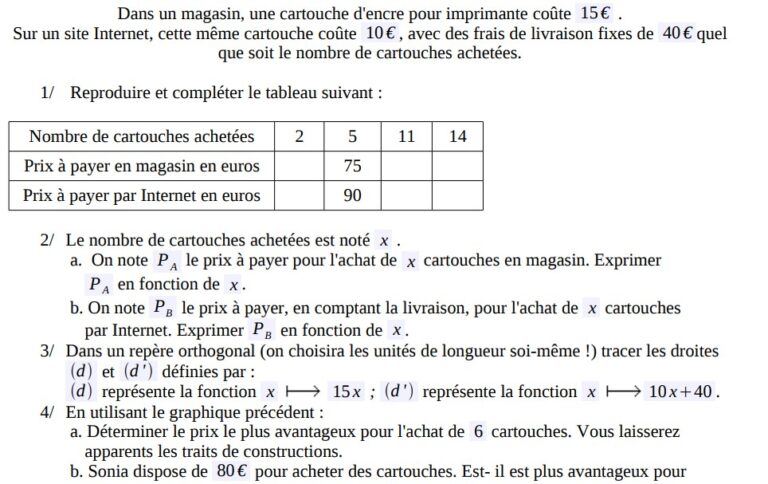
Ok, imagine this: you're at the boulangerie, craving that perfect pain au chocolat. Each one costs €1.50. You're thinking, "Hmm, if I buy two, it's €3; if I buy three, it's €4.50..." Suddenly, BAM! A linear function flashes in your brain. 🤯 (Yeah, maybe that's just me, but bear with me!). That, my friends, is the essence of a linear function in real life. And affine functions? Well, they're like adding a fixed cost – say, a €2 service charge if you want them delivered. Math is everywhere, even in pastries!
So, today, let’s dive into the wonderful (and sometimes slightly terrifying) world of affine and linear functions. We’ll tackle some exercises with detailed solutions so you can conquer these concepts once and for all. No more math anxiety, promise! (Okay, maybe a little. It's math, after all.)
What's the Difference, Anyway?
Let's clear up the confusion right away. The difference between affine and linear functions is subtle but important:
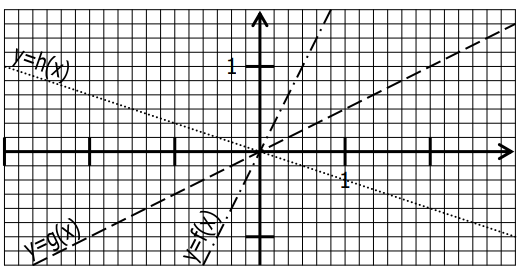
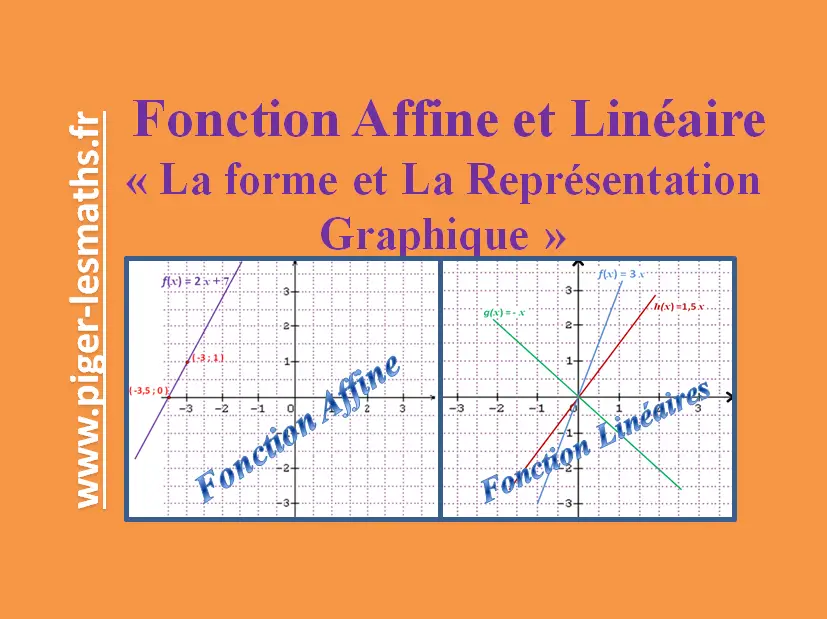
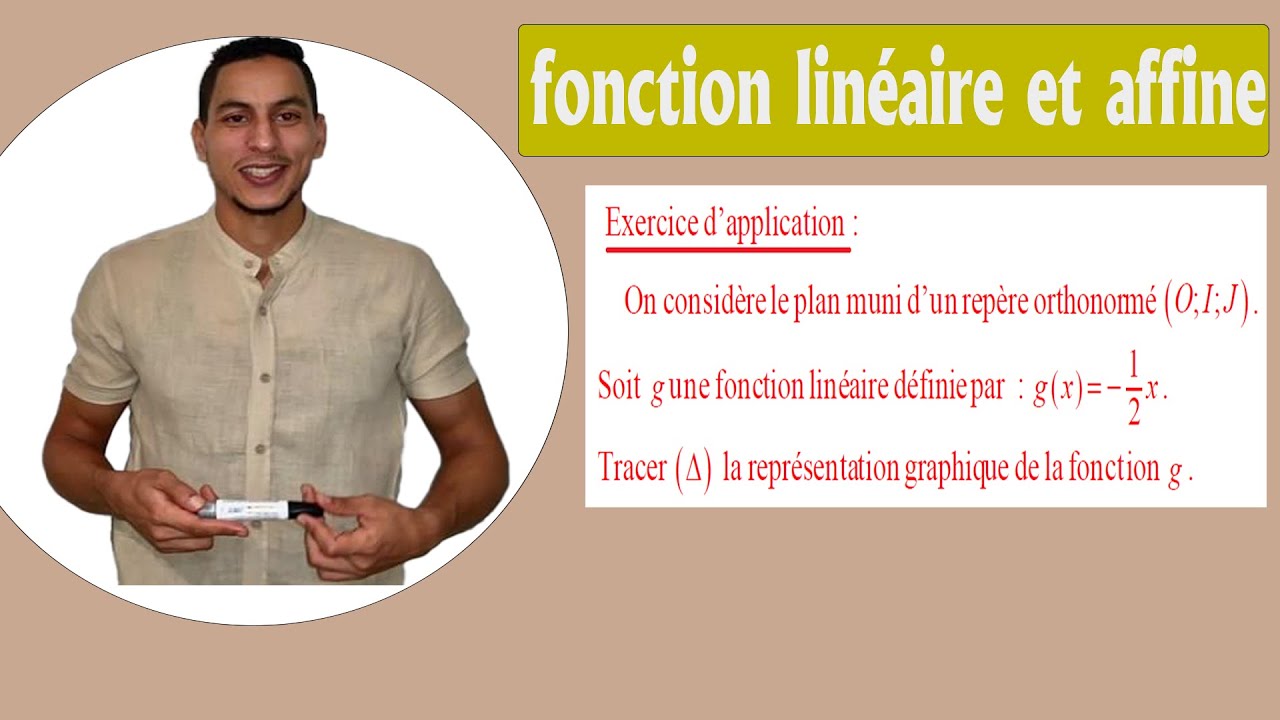
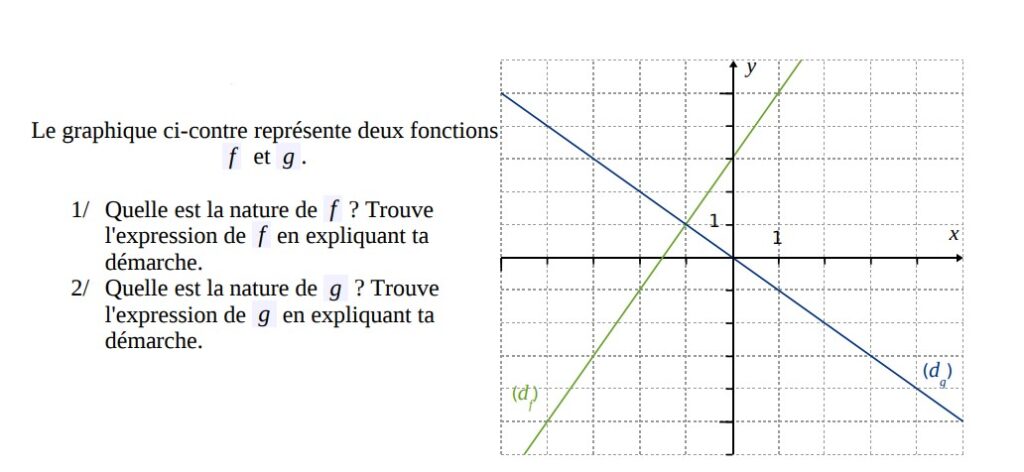
- Linear Function: This is your classic y = mx. It's a straight line that always passes through the origin (0, 0). Think of it as direct proportionality. m is the slope (also called the coefficient directeur in French), telling you how steep the line is.
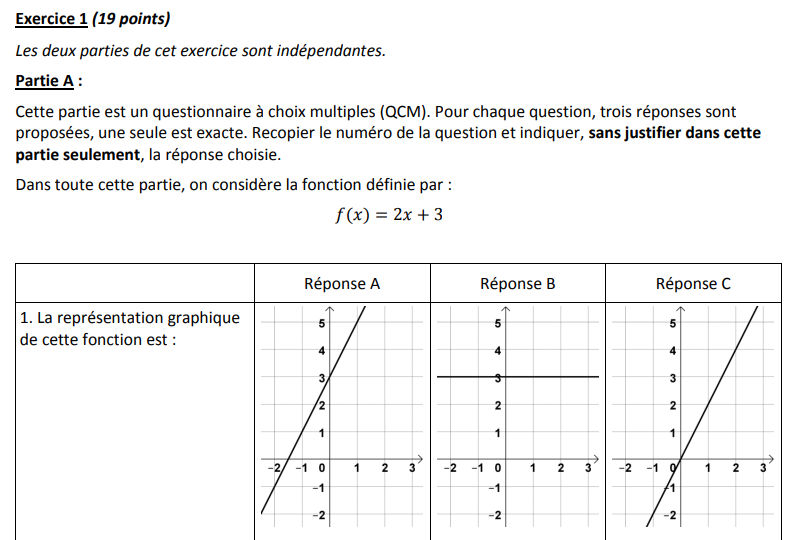
- Affine Function: This is the slightly more general form: y = mx + b. It's also a straight line, but it doesn't necessarily pass through the origin. b is the y-intercept (l'ordonnée à l'origine), where the line crosses the y-axis. So, a linear function is just a special case of an affine function where b = 0.
In French, we say fonction linéaire for linear and fonction affine for affine. Easy peasy, right? (Famous last words... 😉)
Let's Get Our Hands Dirty: Exercises with Solutions
Alright, enough theory. Let’s get into some practice problems. I'll walk you through each one step-by-step, so you can see how it's done.
Exercise 1: Identifying Linear and Affine Functions
Question: Which of the following functions are linear, affine, or neither?
- f(x) = 3x + 2
- g(x) = -5x
- h(x) = x2 - 1
- i(x) = 7
- j(x) = (x/2) - 4
Solution:
- f(x) = 3x + 2: This is an affine function because it's in the form mx + b, where m = 3 and b = 2.
- g(x) = -5x: This is a linear function because it's in the form mx, where m = -5. It passes through the origin.
- h(x) = x2 - 1: This is neither linear nor affine because it contains x2. Linear and affine functions only involve x to the power of 1. (Think straight lines, not curves!)
- i(x) = 7: This is an affine function (though a special one!). You can think of it as f(x) = 0x + 7. It's a horizontal line.
- j(x) = (x/2) - 4: This is an affine function. We can rewrite it as j(x) = (1/2)x - 4, so m = 1/2 and b = -4.
Did you get them all right? Don't worry if not! Practice makes perfect (as your math teacher probably told you a million times). 😉
Exercise 2: Finding the Equation of a Line
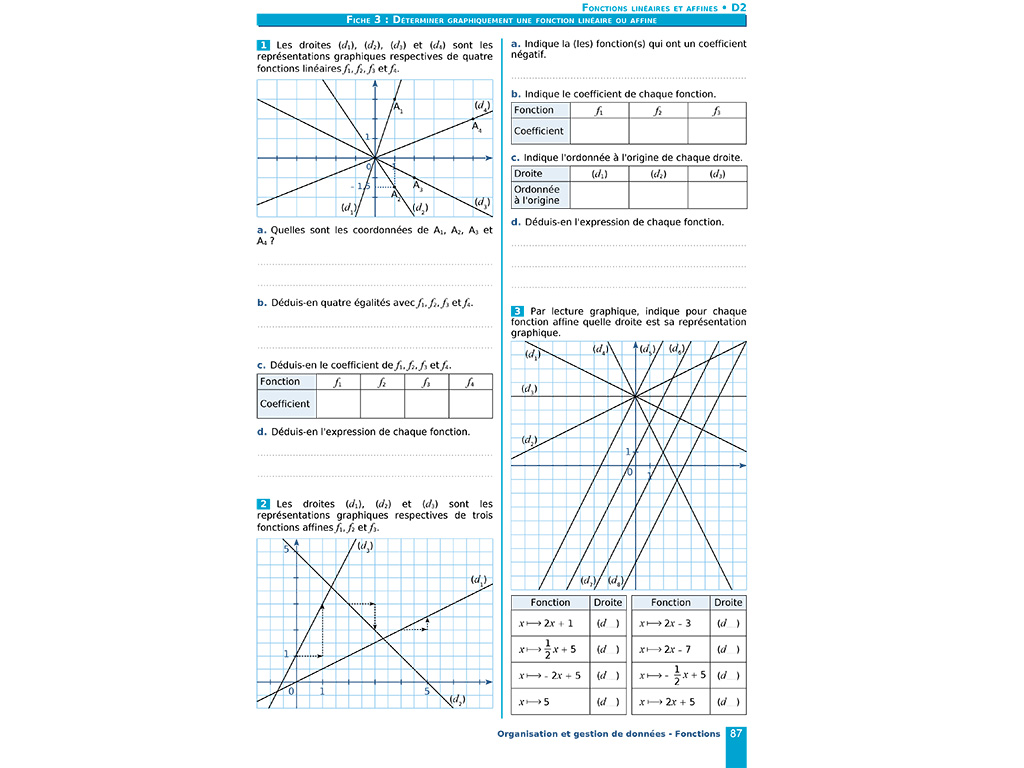
Question: Find the equation of the line that passes through the points (1, 5) and (3, 11).
Solution:
First, we need to find the slope, m. The formula for the slope is:
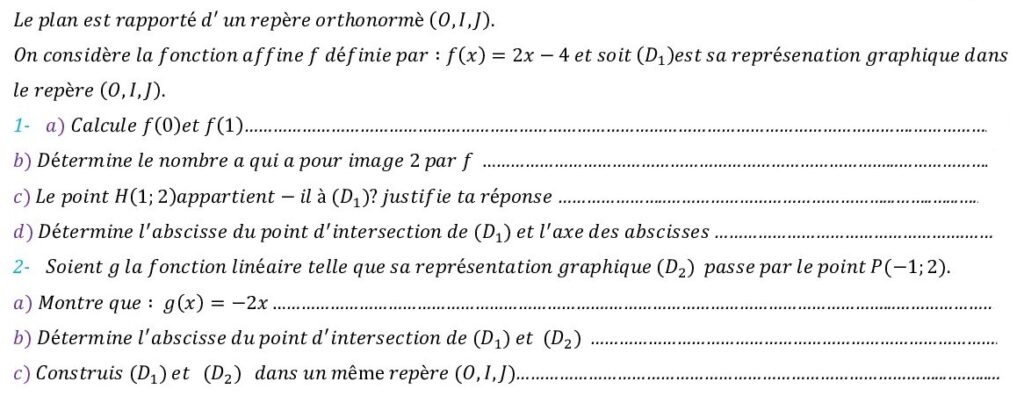
m = (y2 - y1) / (x2 - x1)
Plugging in our points:
m = (11 - 5) / (3 - 1) = 6 / 2 = 3
So, our equation is now y = 3x + b. We need to find b.
We can use either of the given points to solve for b. Let's use (1, 5):
5 = 3(1) + b
5 = 3 + b
b = 2

Therefore, the equation of the line is y = 3x + 2.
See? Not so scary after all! (Unless you hate fractions... then maybe a little scary. 😬)
Exercise 3: Graphing Affine Functions
Question: Graph the function f(x) = -2x + 3.
Solution:
To graph an affine function, you really only need two points. Here's how we can find them:
- Find the y-intercept: This is where x = 0. So, f(0) = -2(0) + 3 = 3. The y-intercept is (0, 3).
- Find another point: Choose any value for x. Let's say x = 1. Then, f(1) = -2(1) + 3 = 1. So, another point on the line is (1, 1).
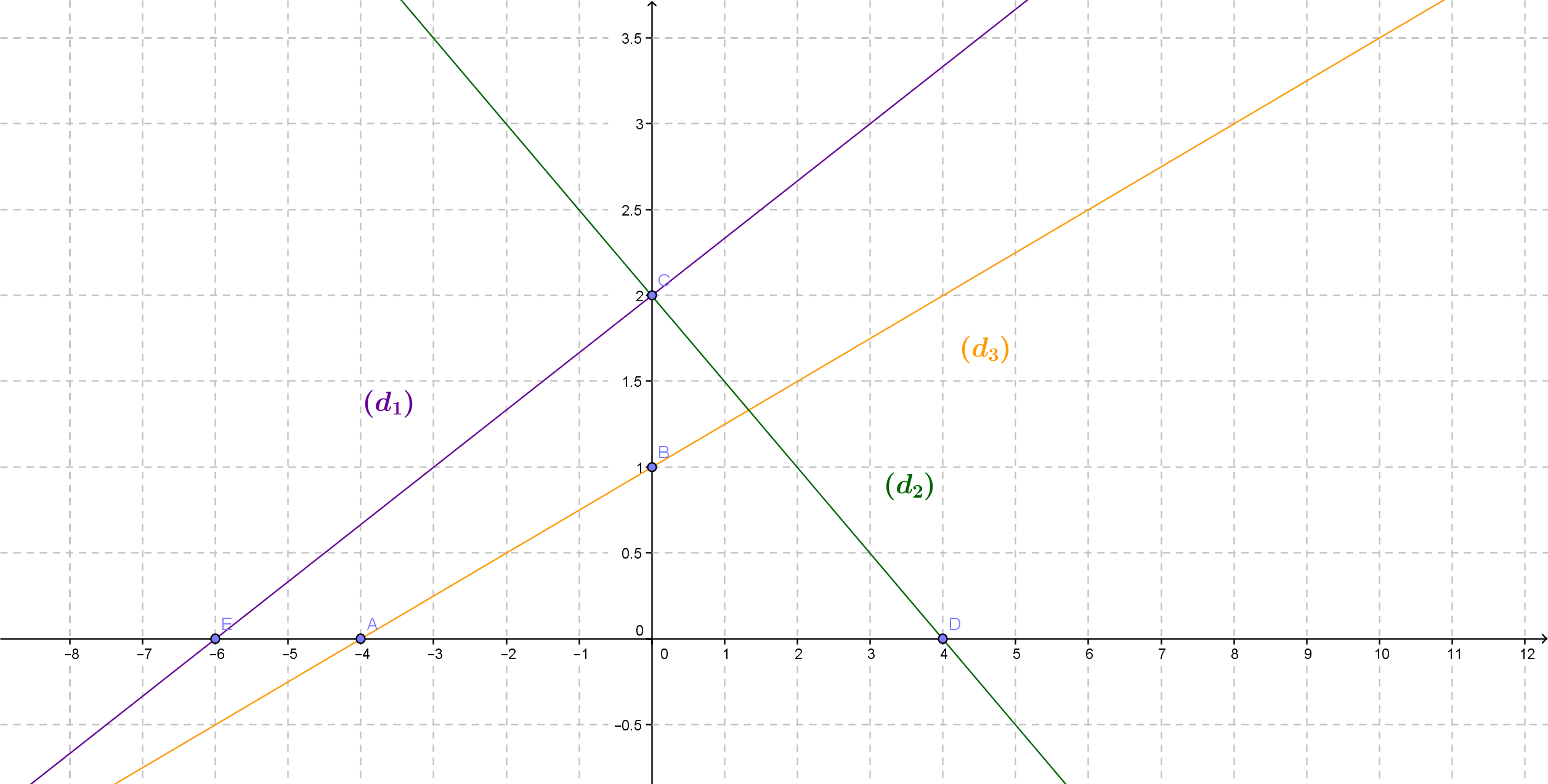
Now, plot these two points on a graph and draw a straight line through them. Voila! You've graphed the affine function.
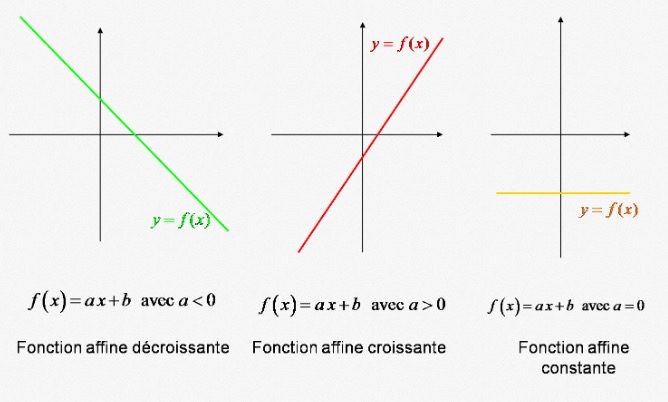
Important Note: A negative slope (like -2 in this example) means the line goes downwards as you move from left to right. A positive slope means the line goes upwards.
Exercise 4: Solving Equations with Affine Functions
Question: Solve the equation 4x - 7 = 9 for x.
Solution:
This is a basic algebra problem, but it's still important! We want to isolate x.
- Add 7 to both sides: 4x - 7 + 7 = 9 + 7 => 4x = 16
- Divide both sides by 4: 4x / 4 = 16 / 4 => x = 4
Therefore, the solution is x = 4.
Pro-tip: Always check your answer by plugging it back into the original equation! 4(4) - 7 = 16 - 7 = 9. It works!
Exercise 5: Word Problem (Because Math Isn't Just About Numbers!)
Question: A taxi charges a fixed fee of €3 plus €2 per kilometer. Write an equation for the total cost, C, as a function of the number of kilometers, k. Then, find the cost of a 10-kilometer ride.
Solution:
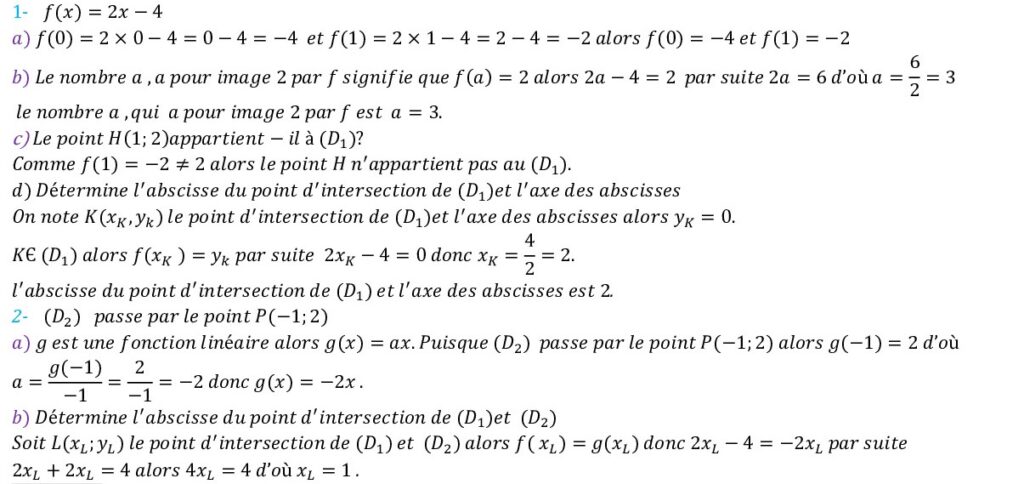
The equation for the total cost is:
C(k) = 2k + 3
Where:
- C(k) is the total cost
- k is the number of kilometers
- 2 is the cost per kilometer (€2)
- 3 is the fixed fee (€3)
To find the cost of a 10-kilometer ride, we plug in k = 10:
C(10) = 2(10) + 3 = 20 + 3 = 23
Therefore, the cost of a 10-kilometer ride is €23.
See how affine functions can be used to model real-world situations? That's pretty cool, right? (Or maybe I'm just a math nerd... 🤔)
Key Takeaways
Here's a quick recap of what we've covered:
- Linear Functions: y = mx (straight line through the origin)
- Affine Functions: y = mx + b (straight line, not necessarily through the origin)
- Slope (m): The steepness of the line.
- Y-intercept (b): Where the line crosses the y-axis.
- Graphing: You only need two points to graph a straight line.
- Word Problems: Affine functions can model many real-world scenarios.
Keep Practicing!
The key to mastering affine and linear functions is practice, practice, practice! Find more exercises online, in textbooks, or even create your own. The more you work with these concepts, the easier they will become. And remember, don't be afraid to ask for help if you're stuck. There are plenty of resources available, including teachers, tutors, and online forums. You got this! 💪
Now go forth and conquer those equations! And maybe treat yourself to a pain au chocolat afterwards. You deserve it! 😉