Salut les amis! Ready for a little French rendezvous? Today, we’re diving into a super common, yet sometimes tricky, part of French grammar: the passé composé of the verb venir (to come). Trust me, mastering this little guy will unlock a whole new level of fluency and confidence when you're chatting with your Parisian pals (or even just ordering a café at your local French bakery).
Le Passé Composé: A Quick Refresher
First things first, let's have a quick recap of what the passé composé actually is. It's the most common way to express the past tense in French. Think of it as the equivalent of the English "I came," "I have come," or "I did come." It’s formed with two elements:
- An auxiliary verb (either avoir or être – more on this later!).
- The past participle of the main verb.
For example, j'ai mangé (I ate) uses avoir and the past participle of manger (to eat).
Venir and Être: A Match Made in Grammatical Heaven
Now, here’s where venir gets a bit special. Most verbs in the passé composé use avoir as the auxiliary verb. However, a select group of verbs, mostly verbs of motion or reflexive verbs, use être. And guess what? Venir is one of them!
Why être? Well, it's all about the inherent movement involved. Être gives a sense of being at a place, becoming something, or departing. It emphasizes a change of state or location.
Conjugating Venir in the Passé Composé
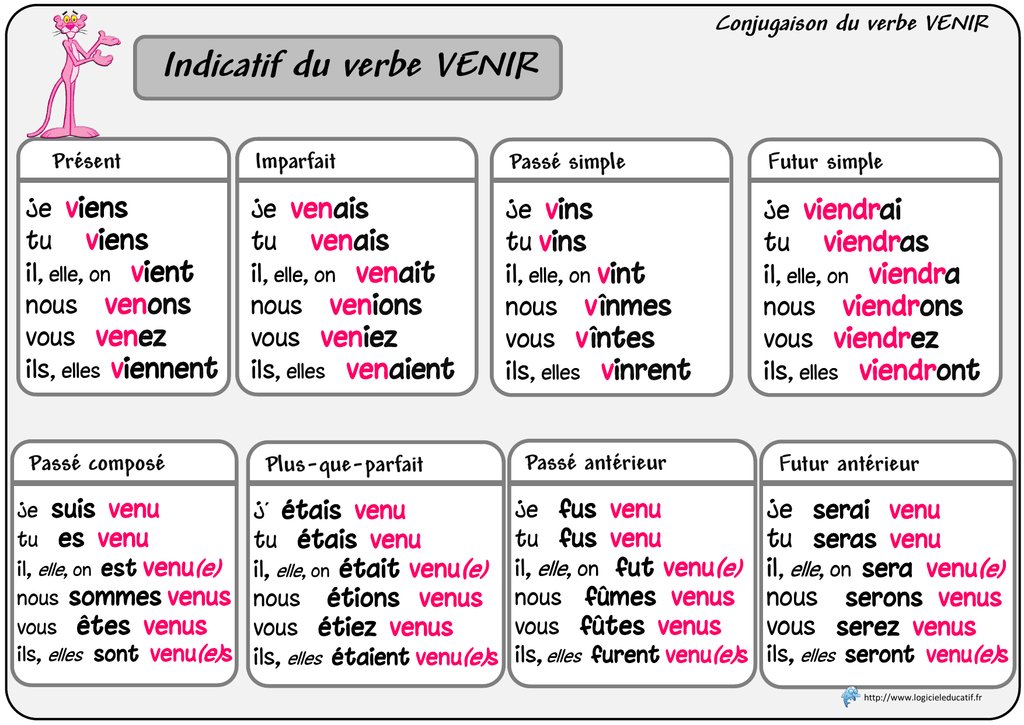
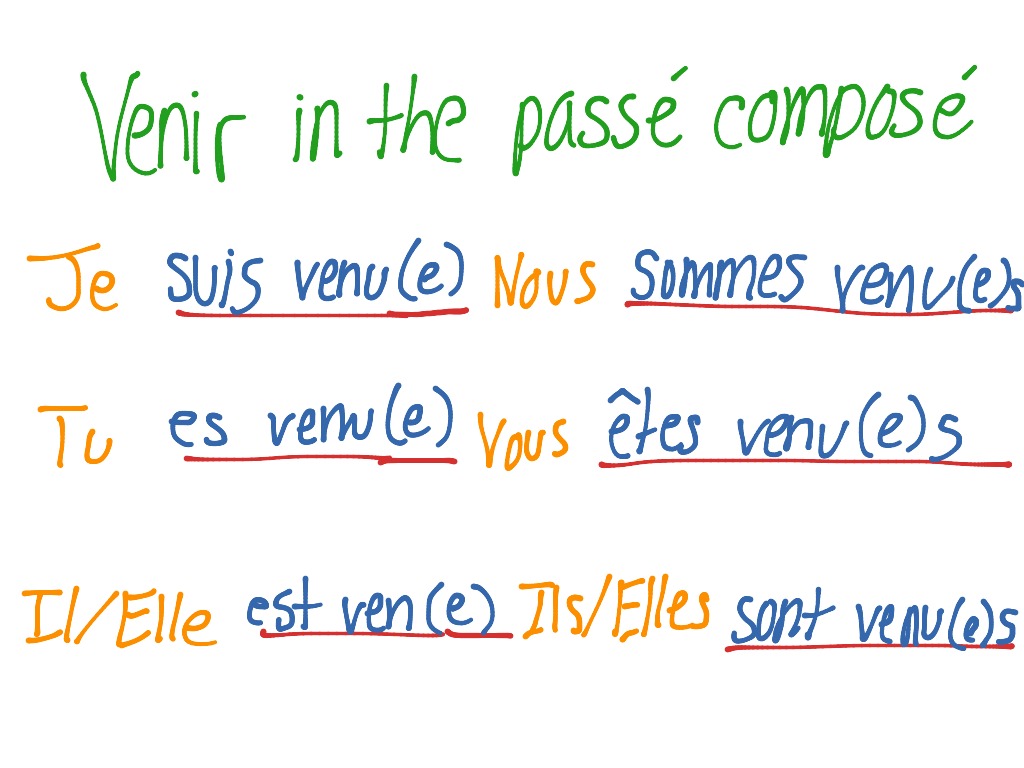
So, how do we put it all together? Here's the full conjugation of venir in the passé composé:
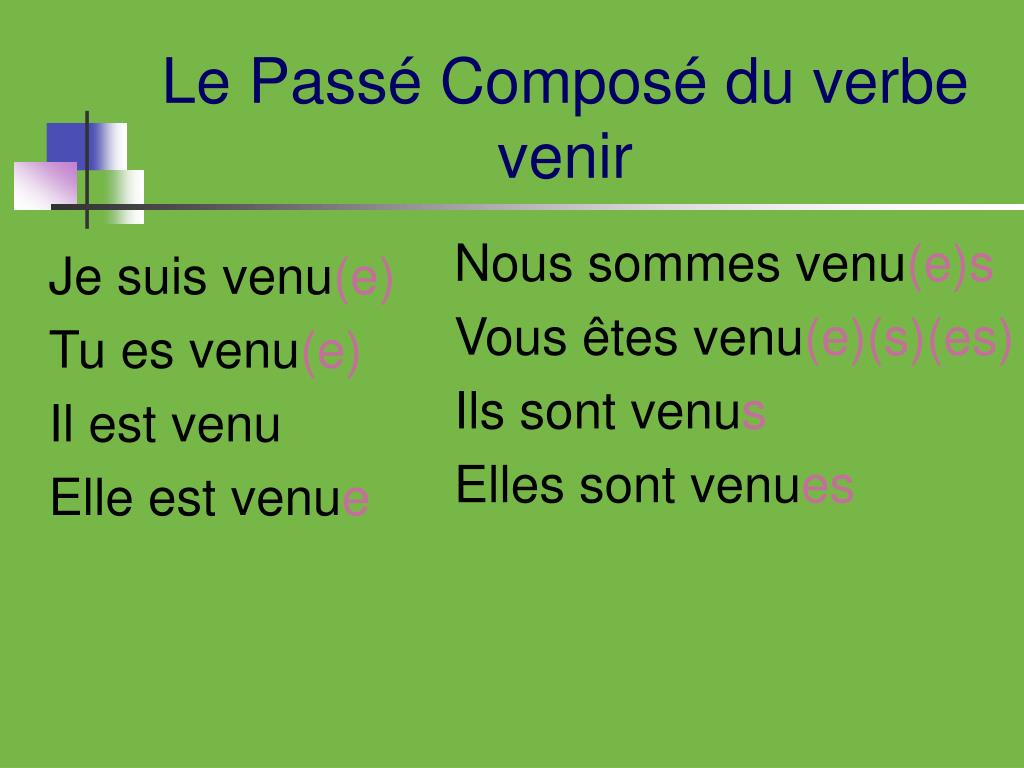
- Je suis venu(e) (I came)
- Tu es venu(e) (You came)
- Il/Elle/On est venu(e) (He/She/One came)
- Nous sommes venu(e)s (We came)
- Vous êtes venu(e)(s) (You came)
- Ils/Elles sont venu(e)s (They came)
Important Note: Did you notice the little (e) and (s) in parentheses? That's the agreement of the past participle with the subject. Because we use être, the past participle venu needs to agree in gender and number with the subject. This means:
- Add an -e if the subject is feminine singular (e.g., Elle est venue - She came).
- Add an -s if the subject is masculine plural (e.g., Ils sont venus - They came).
- Add -es if the subject is feminine plural (e.g., Elles sont venues - They came).
Examples in Action: Putting Venir to Use
Let’s see how venir works in real-life sentences:
- Je suis venu te voir hier. (I came to see you yesterday.)
- Elle est venue à la fête avec son frère. (She came to the party with her brother.)
- Nous sommes venus en train. (We came by train.)
- Vous êtes venues nous rendre visite? (Did you (plural, feminine) come to visit us?)
- Ils sont venus en avance. (They came early.)
The 'Dr Mrs Vandertramp' Verbs: Your Être Cheat Sheet
Okay, let's address the elephant in the room: how do you remember which verbs use être in the passé composé? There's a handy mnemonic device that many French learners use: Dr. & Mrs. Vandertramp. Each letter represents a verb that takes être:

- Devenir (to become)
- Revenir (to come back)
- Monter (to go up)
- Rester (to stay)
- Sortir (to go out)
- Venir (to come)
- Aller (to go)
- Naître (to be born)
- Descendre (to go down)
- Entrer (to enter)
- Rentrer (to re-enter)
- Tomber (to fall)
- Retourner (to return)
- Arriver (to arrive)
- Mourir (to die)
- Partir (to leave)
Keep this list in your back pocket, and you'll be conjugating like a pro in no time!
Common Mistakes and How to Avoid Them
Even seasoned French speakers sometimes stumble with the passé composé. Here are a couple of common pitfalls to watch out for:
- Forgetting the agreement: Always double-check that the past participle agrees with the subject when using être. A simple -e or -s can make all the difference!
- Using avoir instead of être: This is a classic! Refer back to the Dr. & Mrs. Vandertramp list to remind yourself which verbs require être.
Cultural Connection: Venir de…
Here’s a cool little cultural tidbit: the expression venir de + infinitive means "to have just done something." For example, Je viens de manger means "I have just eaten." It's a fantastic way to express recent actions and adds a certain je ne sais quoi to your French.
Imagine this: You're in Paris, strolling along the Seine, and a friend asks if you want to grab a crêpe. You can reply, Non, merci, je viens de manger (No, thanks, I just ate). Boom! Instant French sophistication.
Practical Tips for Mastering Venir
- Practice, practice, practice: Conjugate venir aloud. Write sentences using it in different contexts. The more you use it, the more natural it will become.
- Listen to French: Pay attention to how native speakers use venir in conversations, movies, and songs. This will help you internalize the correct usage.
- Use flashcards: Create flashcards with different subjects and conjugate venir in the passé composé. This is a great way to drill yourself on the agreement rules.
- Embrace mistakes: Don't be afraid to make mistakes! They're part of the learning process. The important thing is to learn from them and keep practicing.
Real-World Application
Let's say you're chatting with a friend about your weekend. You might say, "Je suis venu te voir, mais tu n'étais pas là" (I came to see you, but you weren't there). Or, perhaps you're discussing your travels: "Nous sommes venus en France l'année dernière" (We came to France last year).
These are everyday scenarios where understanding and using the passé composé of venir will make a huge difference in your ability to communicate effectively in French.

Even when telling a simple anecdote to your friends, “Je suis venu en retard ce matin à cause du traffic!” (I came late this morning because of traffic!) will improve the flow of the conversation.
Final Thoughts
So, there you have it! Mastering the passé composé of venir might seem like a small detail, but it's a crucial step towards fluency. It allows you to talk about past experiences, share anecdotes, and connect with others in a meaningful way. Remember the agreement rules, the Dr. & Mrs. Vandertramp verbs, and most importantly, keep practicing. Before you know it, you'll be using venir like a true Parisien.
Now go out there and tell the world all the amazing places you êtes venu(e)s! À bientôt!





+Comment+est-ce+qu’on+conjugue+venir+Au+passé+composé+Au+futur+je.+nous.+tu..jpg)

![Le Verbe Venir - [ppt Powerpoint] 42D](https://i.ytimg.com/vi/E5QI2BlW6iw/maxresdefault.jpg)